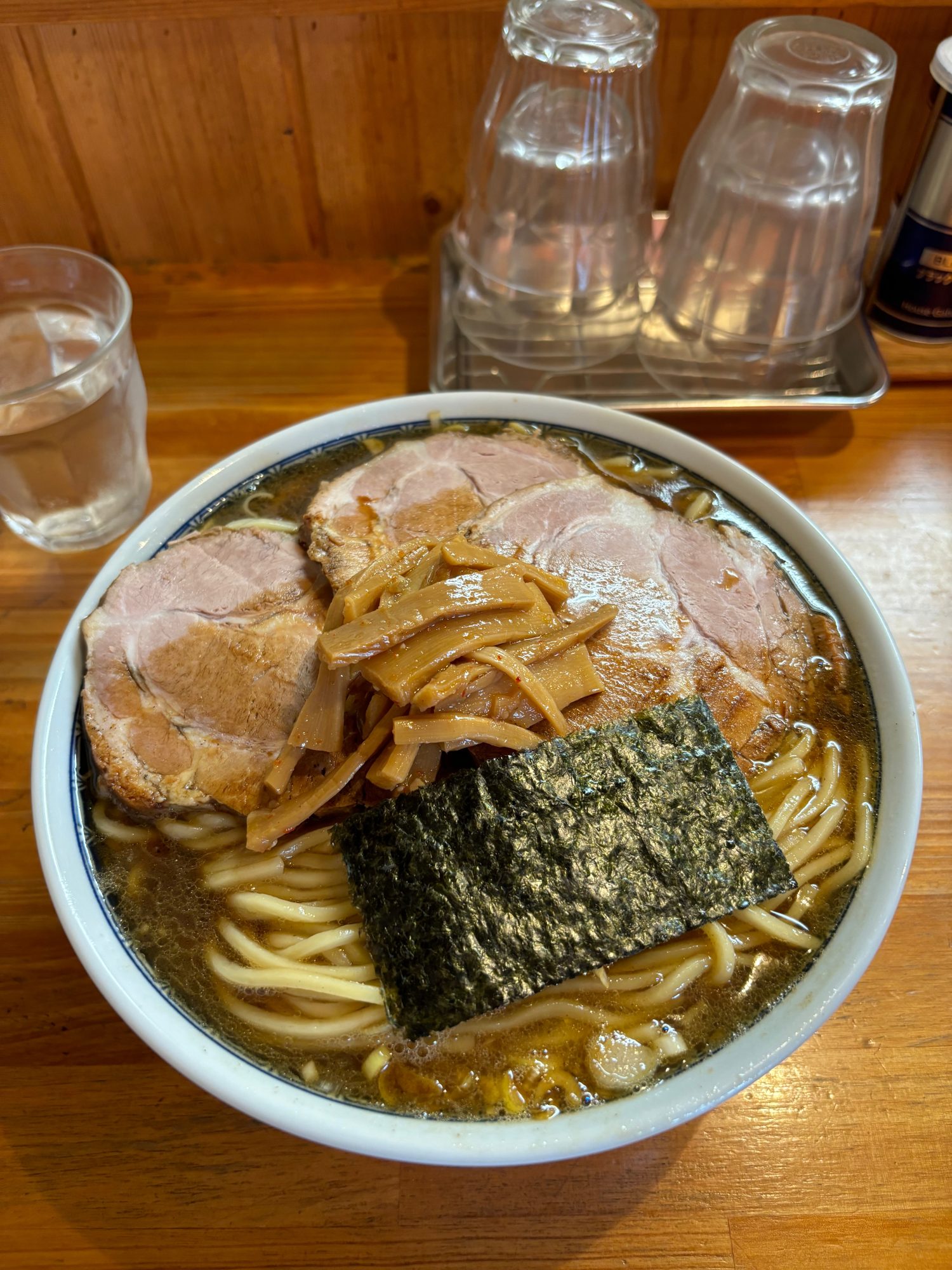
Tokyo has somewhere north of three thousand ramen shops. The ones that appear in English-language guides are usually the same eight, and they are usually famous because they were famous first — a shop gets written up, the write-up gets cited, the citation gets cited, and eventually there is a forty-minute queue outside a bowl that is good but not extraordinary.
None of the shops below have that problem. Most of them have never been written about in English at all.
What follows is organised by style rather than by ranking, because “best ramen in Tokyo” is a meaningless phrase until you know whether you want a clean shoyu bowl or a mountain of pork and bean sprouts. Work out which style you are after first, then pick the shop.
Quick Picks
- If you only eat one bowl — Hope Ken, open since 1935.
- Best miso — Misokko Hook in Ogikubo, a 3.9 on Tabelog.
- Best chicken broth — Ayagawa in Ebisu.
- Best if you are new to jiro-kei — Buta-Yama.
- Best if you are not — Ikedaya in Takadanobaba.
- Best late night — Hope Ken, which never closes.
- Best in Shibuya — Kiraku, open since 1952.
A Quick Guide to Tokyo Ramen Styles
If you read nothing else, read this. Picking the right style matters more than picking the right shop.
| Style | What it is | Good for |
|---|---|---|
| Shoyu / chuka soba | Soy sauce base, usually chicken or pork stock, simple toppings. The traditional Tokyo bowl. | Your first bowl. Nothing to be intimidated by. |
| Shio | Salt base. Lighter and cleaner, lets the stock do the talking. | Anyone who finds ramen heavy. |
| Miso | Fermented soybean paste base. Thick, sweet-savoury, warming. | Winter, and anyone who thinks they don’t like ramen. |
| Tonkotsu | Pork bone broth boiled until it goes opaque and creamy. | Rich food lovers. More a Kyushu style than a Tokyo one. |
| Iekei | Yokohama-born hybrid of shoyu and tonkotsu, served with spinach and nori. | People who want both at once. |
| Jiro-kei | Huge portions, thick noodles, heavy pork soup, a mountain of vegetables, call-out toppings. | Big eaters. A subculture as much as a dish. |
| Tsukemen | Cold firm noodles served beside a concentrated hot dipping broth. | Summer, and anyone bored of soup. |
| Mazesoba | No soup at all. Noodles tossed with tare, oil and toppings. | Anyone who wants flavour without a bowl of liquid. |
Shoyu and Chuka Soba: The Tokyo Classic
Hope Ken — Sendagaya
ホープ軒 · 9 minutes from Sendagaya Station · Open 24 hours · Cash or card · Ticket machine

In business since 1935. That number carries the whole recommendation — this shop fed people through the war, through the postwar rebuild, through the bubble and the crash, and it is still on the same corner serving the same thing at four in the morning.
It is open twenty-four hours a day, which for an independent shop in Tokyo is genuinely unusual, and it sits near the national stadium and the Meiji Jingu Gaien grounds — I think it has the best location of any ramen restaurant in Japan.
They created “chacha style ramen” – pork bone and soy sauce base with heaps of back fat sprinkled over top. All these combine for a strong, punchy soup that is as good as it is addicting.
Chūkamenten Kiraku — Shibuya
中華麺店 喜楽 · 3 minutes from Shibuya Station · Closed Wednesdays · Cash only · Order before you sit

Open on Dogenzaka since 1952, which makes it one of the oldest ramen shops in Shibuya and about seventy years older than most of what surrounds it. Three minutes from the scramble crossing, in the most photographed square kilometre in the country, the clientele is still mostly local.
Practical note: you order before you sit down here. Decide at the door.
Went with the classic cha-shu wonton soup. The broth was amazing – super flavourful yet not overly salty. This mixed with the aroma from the garlic chips and various toppings made for an excellent bowl.
Kashiwagi — Higashi-Nakano
かしわぎ · 3 minutes from Higashi-Nakano Station · Closed Tuesdays · Cash only · Ticket machine

Two stops from Shinjuku on the Chuo-Sobu line and a completely different world. Higashi-Nakano is residential and quiet, and Kashiwagi sits tucked away in it doing a soy-sauce based bowl that has been voted onto serious ramen rankings.
Lunch only — it closes at 3pm and does not reopen. Plan around that.
A bowl that doesn’t try to overcomplicate things, but rather hones in on what they already do well. A perfect soy-sauce based soup with thin, slightly al-dente noodles. What more could you ask for?
Kitaotsuka Ramen — Otsuka
北大塚ラーメン · 4 minutes from Otsuka Station · Closed Sundays · Cash only · Ticket machine

Another Yamanote line shop, which makes it easy to reach from almost anywhere on your itinerary. A stronger soy sauce base, topped with chashu pork, in a part of Tokyo most visitors pass through without stopping.
Otsuka is worth ten minutes of walking around on its own — it is one of the last stretches of the Yamanote loop that still feels like a neighbourhood rather than a district.
Extremely tender chashu that literally melts in your mouth. There are very few ramen shops that do it as well as they do here at Kitaotsuka Ramen.
→ Full review of Kitaotsuka Ramen
Chuka Soba Menpeki Kunen — Kamiigusa
中華そば 麺壁九年 · Suginami City · Cash only · Ticket machine

A small shop I almost walked straight past. Lighter shoyu, out in Suginami, with genuine character to it — this is the far end of the “one street back” principle, out where the city stops performing for anyone.
The broth had a clarity to it that told me a lot of care went into it’s preparation. It was light yet flavourful at the same time. A very good bowl if you like a not so overpowering soy-sauce based soup.
→ Full review of Menpeki Kunen
Toshioka — Waseda
自家製中華そば としおか · 7 minutes from Waseda Station · Lunch only, Mon–Sat · Cash only · Ticket machine

Toshioka has house rules and enforces them. That reputation puts some people off, and it should not — the rules exist because the shop is small, the queue is long, and the owner has decided that the bowl matters more than the atmosphere. Follow the posted instructions, eat, leave, and you will have had one of the best bowls near Waseda.
It is also a good illustration of something about Tokyo: strictness in a small shop is almost never hostility. It is throughput.
The bowl was volumous. Thick chashu, lots of toppings, excellent noodles, and an even better soup. The soup had an amazing punch to it that kept having me drink more despite being on the verge of going into a food coma.
Jyunteuchi Daruma — Nakano-Fujimicho
純手打ち だるま · 1 minute from Nakano-Fujimicho Station · Cash only · Ticket machine

Run by one chef. Everything hand-made — that is what junteuchi means, and it is not a marketing word here.
A one-person shop is worth seeking out specifically because it cannot scale. Whatever you are eating was made by the person standing in front of you, which is a different proposition from a bowl assembled to a chain’s spec sheet. It also means limited hours and limited seats, so go early.
There is a window in front of the building where the owner/chef makes his own noodles nearly every night. The elasticity of them is some of the best I have ever had.
→ Full review of Jyunteuchi Daruma
Miso
Misokko Hook — Ogikubo
味噌っこ ふっく · 10 minutes from Ogikubo Station · Cash or card · Ticket machine

Miso is the style visitors skip most often, because Tokyo is associated with shoyu and everyone assumes miso belongs to Sapporo. Misokko Hook is the counterargument.
It holds a 3.9 on Tabelog. That deserves explaining, because it reads as mediocre to anyone used to five-star systems. Tabelog grades brutally: a 3.5 is genuinely good, and anything at 3.8 or above puts a shop in a tiny fraction of the country’s restaurants. Ramen specialists travel across Tokyo for a 3.9.
Ogikubo has been a ramen neighbourhood for decades, which is part of why a shop this good can survive here — the local standard is high enough that anything mediocre closes.
They cook their ramen the traditional way – using a wok where they fry up aromatics like garlic, miso paste and then pour the soup stock in. It is one of the top 3 ramen soups I have ever had.
Chicken and Lighter Bowls
Ayagawa — Ebisu
綾川 · 4 minutes from Ebisu Station · Cash only · Electronic ticket machine

Built around an oyadori broth — stock made from mature laying hens rather than young birds, which gives a much deeper, more savoury chicken flavour than you get from standard chicken stock. Chewy noodles to match.
Chicken-based ramen is the style I recommend to people who find pork broths too rich. You can drink more of it, and it does not sit on you afterwards.
Ebisu is also one of the more pleasant neighbourhoods to be walking around in the evening, and there is a very good cafe five minutes away if you want to sit somewhere afterwards.
They use both chicken bones and chicken oil to make their soup. It is so rich and it tastes like you are drinking liquid gold. Just know that it may ruin chicken noodle soup for you.
Jiro-kei: The Deep End
Jiro-kei descends from Ramen Jiro and it is less a dish than a subculture. Enormous portions. Thick, chewy noodles. A heavy pork soup. A mountain of bean sprouts and cabbage. A ritual where you call out your toppings — garlic, extra vegetables, extra back fat — as the bowl is being finished.
Two rules. Order the small; the small is not small. And do not plan another meal that day.
Buta-Yama — multiple locations
ラーメン豚山 · Cash, some locations take card · Ticket machine

Start here. Buta-Yama is a chain, which normally disqualifies a shop from this site, but it is the single best introduction to jiro-kei in Japan — the format without the punishment, and locations across the city so you do not have to plan around it.
Learn the ordering ritual here, then graduate.
Ikedaya — Takadanobaba
ラーメン池田屋 · 5 minutes from Takadanobaba Station · Closed Thursdays · Cash only · Ticket machine

One of the top jiro-kei shops in Tokyo, and the chashu is what people come for specifically.
Takadanobaba is a student neighbourhood, which explains both the portion sizes and the prices. It is also one of the best-value places to eat in the whole city — I wrote a separate review of Yobocho two minutes from the same station if you want the opposite kind of meal.
Chashu so tender it starts to break apart when you pick it up with your chopsticks. It is also seasoned to perfection – definitely some of the highest quality in Japan.
Tsukemen and Mazesoba: Ramen Without the Soup
Marucho — Mejiro
丸長 · 5 minutes from Mejiro Station · Closed Sundays · Cash only · Call-out system

Tsukemen means the noodles arrive cold and firm on one plate and the broth arrives hot and concentrated in a bowl beside them. Because the noodles are not sitting in liquid they hold their texture to the last bite, and because you are not drinking the broth by the bowlful it can be pushed much harder on flavour.
Marucho is just off the Yamanote line at Mejiro, hugely popular locally, and essentially invisible to visitors. It uses a call-out system rather than a ticket machine — you order verbally — which is the thing that intimidates people most and is genuinely fine.
The broth is flavourful and filled with little bits of chashu. Once you are finished with your noodles you can also get the staff to give you boiling water to make it into a soup.
Paimen — Nakameguro
百麺 · 4 minutes from Nakameguro Station · Open until midnight · Cash or card · Ticket machine

Mazesoba has no soup at all — the noodles are tossed with tare, oil and toppings and you mix the whole thing yourself. Paimen’s version is built on chicken oil, and the back fat gyoza on the side are the reason to order two portions of everything.
Open until midnight, four minutes from Nakameguro station, in a neighbourhood that is genuinely lovely to walk through along the river.
What looks like a plain bowl of noodles with no soup actually has various flavourings sitting at the bottom of the bowl waiting to be mixed. Stir it well and then slurp it up – it will surprise you how incredible it tastes.
Spicy
Mouko Tanmen Nakamoto — Shinjuku
蒙古タンメン中本 · 8 minutes from Shinjuku Station · Open 10am–11pm daily · Cash or card · Ticket machine

A chain with 29 locations across Kanto, and probably more famous nationally for its convenience store cup ramen collaboration than for its shops. Included here because what it does is genuinely hard to find elsewhere: spicy miso and spicy salt tanmen, topped with stir-fried vegetables, pork and tofu, on a heat scale that runs from 0 to over 10.
The shop recommends level 5 for beginners. I went with a level 3 miso and it still had a real kick. If you overshoot, there are toppings that mellow it — butter works — and the staff will dilute the soup for you at no charge if you ask.
The white powder on top, by the way, is seabura — back fat. It is a common ramen topping in Japan and I have never had it fail to improve a bowl.
→ Full review of Mouko Tanmen Nakamoto
Worth Leaving Tokyo For: Iekei in Yokohama
Sugitaya — Shinsugita
ラーメン杉田家 本店 · 4 minutes from Shinsugita Station · Open from 5am · Cash only · Ticket machine

Iekei is Yokohama’s own style — a hybrid of shoyu and tonkotsu, thick and creamy, served with spinach and sheets of nori and usually a bowl of rice on the side. Sugitaya is run by a disciple of Yoshimuraya, the shop that invented the style, which makes this about as close to the source as you can get.
It opens at five in the morning. Yokohama is thirty minutes from central Tokyo and this is a legitimate reason to make the trip.
How to Order Ramen in Tokyo
Most ramen shops use a ticket machine. Money in first, then press. The top-left button is almost always the shop’s signature bowl — a convention, not a coincidence. Take the ticket, sit, put it on the counter in front of you.
A few shops use a call-out system instead, where you order verbally. Marucho is one. It is fine — point and say kore o kudasai. I have a full breakdown of every ordering system in Japan if you want to know what you are walking into before you walk into it.
Some other things worth knowing:
- Most ramen shops are cash only. Nine of the shops above are. Carry yen.
- Seating is directed. Staff will often tell you exactly which seat to take, filling from the far end. Do not seat yourself unless invited to.
- People may queue inside, behind you, while you eat. This is normal and it is not pressure. Eat at your normal speed. The first time it happened to me I felt like I was causing an international incident. I was not.
- Slurping is fine. It cools the noodles and it is not rude.
- Order rice. Half a bowl of plain rice dipped into the soup at the end is one of the best ways to finish, and it usually costs about ¥100.
- Lunch hours are short. A lot of the best shops are open 11am to 3pm and that is the whole day.
FAQ
What is the best ramen in Tokyo?
There is no single best, because ramen is divided into styles that are barely the same dish. For a traditional Tokyo shoyu bowl, Hope Ken in Sendagaya has been running since 1935. For miso, Misokko Hook in Ogikubo holds a 3.9 on Tabelog. For chicken broth, Ayagawa in Ebisu. Pick the style first, then the shop.
How much does ramen cost in Tokyo?
A bowl at a local shop typically costs ¥900–1,200. Toppings run ¥100–300 and a side of rice is usually around ¥100–150. A full meal with a topping and rice generally lands under ¥1,500, and most shops are cash only.
Do you need to queue for good ramen in Tokyo?
Sometimes, but not as often as people assume, and the queue is not a reliable quality signal. Near tourist landmarks a long line usually means social media attention. In a residential neighbourhood at lunchtime it means the food is good. Arriving before noon or after 1:15pm avoids most waits.
What is the difference between ramen and tsukemen?
In ramen the noodles are served in the soup. In tsukemen the noodles are served cold and firm on a separate plate beside a hot, concentrated dipping broth. Because the noodles never sit in liquid they hold their texture, and because you are not drinking the broth by the bowlful it can be far more intense.
What is jiro-kei ramen?
Jiro-kei is a style descended from Ramen Jiro, defined by enormous portions, thick noodles, heavy pork broth and a mountain of bean sprouts and cabbage. You call out your free toppings as the bowl is assembled. Order the small size — it is not small.
Is it rude to eat ramen alone in Japan?
No. Ramen shops are built for solo diners — counter seating, ticket machines, fast turnover. Eating alone is completely normal and a large share of the customers at every shop above will be by themselves.
Can you use a credit card at ramen shops in Tokyo?
Usually not. Small independent ramen shops are overwhelmingly cash-only, and ticket machines often take cash or IC cards only. Carry yen and check for a card sticker on the door before you sit down.
Where to Go From Here
If ramen is your main reason for visiting, the useful move is to pick one style per day rather than trying to eat four bowls in a row — they blur together fast, and the shops with the shortest hours are usually the ones worth planning around.
For everything else Tokyo does well, the full archive of restaurant reviews is here, and you can browse everything in Tokyo and the Kanto region in one place.
Leave a Reply