• Ikedaya – One Of The Top Jiro-Kei Ramen Shops With Amazing Chashu In Tokyo!

    Must know Info:

    Ramen Ikedaya – ラーメン池田屋 東京高田馬場店 *Cash Only*

    1 Chome-3-13 Shimoochiai, Shinjuku City, Tokyo 161-0033, Japan

    5 minute walk from Takadanobaba Station

    Hours (as of 2026/03): 11am – 2:30pm, 5-9pm Friday to Wednesday

    Order system: Ticket Machine

    Ikedaya is one of the top jiro-kei ramen restaurants in Tokyo, and even though their main location is in Kyoto (under the same name), I would argue that the Tokyo one is more popular. 

    If you want to know what jiro-kei ramen is more in depth than I suggest reading this blog post by me: https://localeatsjapan.com/2025/12/19/buta-yama-the-best-beginner-jiro-kei-ramen-in-japan/

    But in short, they are known for their outrageous toppings and volume of food they serve – Ikedaya is no different, but it is a lot more manageable than other places I must say, and this also goes for the ease of ordering. 

    When I went for the first time it was on a weekend I believe and so the lineup outside the shop was about 30 people deep, but like most ramen restaurants in Japan, there is a really fast turnover speed so I would say I waited no more than 30 minutes (maybe a little more). 

    When you are lining up you may see people in front of you go into the shop to get their food ticket from the ticket machine, so when the people in front of you come back that is your queue to go in and get yours before getting back in line. This makes it seamless for when you are seated in the shop and hand your ticket over to the staff. 

    Note that there is only 1 thing on the menu, and it is, you guessed it, ramen. But there are no size options of anything, this is what makes it a bit confusing but also simple to order. 

    When you are seated at one of the 10 ish counter seats the shop has, you will eventually be asked by one of the staff にんにく入れますか (do you want garlic) or something along these lines. What this means is the chance for you to tell the staff of your preferences for sizing, amount of bean sprouts you want on top of your bowl etc. 

    Now, do note that this interaction is likely going to be in Japanese, so it can make it quite difficult to know what is going on depending on your language ability. 

    But if it makes you feel any better, a lot of Japanese people don’t even know what to do when they get in and are asked these questions because jiro-kei ramen shops are very “unique” when it comes to how you order. 

    If you don’t feel comfortable I would just say 全部普通 (zenbu futsuu) which means everything normal portion size. 

    If you want more info on this before you go I would recommend reading an article or watching a youtube video because there are a lot out there that go into this! 

    As for the bowl though, it was incredible, and this is coming from someone who isn’t even the biggest fan of this type of ramen. 

    The size was perfect, and I didn’t have to struggle to finish off the last bites like I have in the past – it was enjoyable from start to finish. 

    The beansprouts on top were seasoned nicely and added a nice crunch/freshness to the bowl. 

    The noodles are thick and soak up the soup excellently. I also always get a raw egg on the side of my jiro-kei and dip the noodles in it – this is a really popular thing to do for fans of this ramen (do not worry about salmonella, Japan’s eggs are safe – trust me!)

    But the star of this bowl was undoubtedly the chasu pork. It was incredibly tender despite the thick size of it and was seasoned to perfection. 

    This is actually some of the best chashu I have ever had. I would even say to go just to try this alone! 

    Overall this is an excellent bowl of jiro-kei ramen and is on the easy side when it comes to ordering so I would highly recommend it for someone that wants to try it for the first time (or those that are veterans)! 

    The staff were also very nice so this is a plus too!

    Thanks for reading – if you’d like to support and follow along: 

    More about me

    Different types of ordering systems in Japan explained

    Purchasing an onigiri to keep me fuelled throughout my journey 🍙

    Planning a trip to Japan? These may help: 

    🗺 Find a food tour near this restaurant — Viator

    🏨 Find a hotel in the area — Booking.com

  • Ryozanpaku – Amazing Meat Sauce Covered Fried Rice In Tokyo!

    Must know Info:

    Ryozanpaku – 中華 梁山泊 *Cash Only*

    〒177-0053 Tokyo, Nerima City, Sekimachiminami, 3 Chome−4−51 梁山泊

    10 minute bus from Ogikubo Station

    Hours (as of 2026/03): 5:30-10:15pm Tuesday-Sunday 

    Order system: Menu

    Ryozanpaku is a gem of a Chinese restaurant located in Tokyo known for their famous “ankake chaahan” which is fried rice topped with a thick meat loaded sauce and I am pretty sure it might be one of the only places that makes it in Japan. 

    Ryozanpaku has been open for nearly 50 years, and is now being run by the son of the original owner. It is very popular with the locals, but I personally know people who will commute out here from a ways away just to eat it – it is that good. 

    While it is in Tokyo, it isn’t Tokyo proper, so you will either have to take a bus or walk a bit of a ways to get here, but it is well worth it. They also have their own parking lot with at least 5 spots so driving is also an option. 

    The inside of the shop consists of counter seats that wrap around the kitchen, and I would say there are about 25 ish. 

    Because this place gets super popular, there are often lineups outside, so just line up and the staff will call you in eventually. 

    When you are seated you will tell your order to someone in front of you in the kitchen and it will come out quite fast. Despite it being a relatively small place there are about 10 staff at all times, and this just goes to show how popular it is.

    Another reason for this is that they do take out, and so you will see people constantly coming in to place orders and pick up – I would even go to say that this is where most of their profit comes from. 

    The water is self-serve and located on the corners of the restaurant, so this is nice when they are busy and you don’t have to wait for someone/feel bad asking them for it. 

    Now onto the food. As I mentioned, the fried rice with this meat-sauce thing is like anything I have ever had before. It is so rich, and the meat is extremely tender. It is like you are drinking soup. Some people might say it is a bit salty, and I agree, but it doesn’t take away from the flavour at all. 

    This personally is one of my top 10 dishes In Japan I think. 

    Besides this, the other dish that was recommended to me by the guy who introduced me to this place was their liver vegetable stir fry. I had only ever tried liver once or twice up until this point and I wasn;t the biggest fan, but when it was served with a good sauce, some good vegetables, and the liver itself was really tender without any off smell. I became an instant fan. 

    I also ordered the mabo-tofu when I went, and while it was good, I had better be honest. So everytime I have gone since it has simply been the ankake-chahan and if I feel up to it, the liver stir-fry.

    They also have other menu items I sure are great, so try out what you think sounds good! 

    Just do note that the servings are very generous to say the least, so do stay a little conservative on the ordering because as I have pictured here, with two people even this was a big challenge to finish (and I eat a lot). 

    This youtube video: https://www.youtube.com/watch?v=sNgf4Q-xydg goes in depth into the story and cooking behind the place so I recommend it before your visit! 

    If you have the chance please come out here! It is like no other food you can find anywhere else. 

    Thanks for reading – if you’d like to support and follow along: 

    More about me

    Different types of ordering systems in Japan explained

    Purchasing an onigiri to keep me fuelled throughout my journey 🍙

    Planning a trip to Japan? This may help: 

    🏨 Find a hotel in the area — Booking.com

  • Matsuba – Popular Chinese Restaurant That Was Featured In A Popular Manga In Tokyo!

    Must know Info:

    Matsuba – 中華料理 松葉 *Cash Only*

    3 Chome-4-11 Minaminagasaki, Toshima City, Tokyo 171-0052, Japan

    8 minute walk from Ochiai-minami-nagasaki Station 

    Hours (as of 2026/03): 11am – 3pm, 5-8pm Tuesday-Sunday 

    Order system: Menu

    If you are a lover of manga, or just restaurants with a really cool history behind them, then this is the place for you. 

    This was a shop that was featured in a relatively popular manga called “manga-michi” or manga road which started in 1970 and ran for about 43-44 years. 

    Because of this, when you go into the shop, and shown in the picture I put up, you can see a ton of famous manga authors whose signature and most recognizable characters are posted on the wall. 

    For example, the author of slam dunk and doraemon, some of Japan’s most popular manga of all time, have visited this shop, so it is safe to say it is very popular among fans of this community. 

    I personally didn’t know this was the case at all before I went, and simply just came across this restaurant randomly, but it was very cool to find out its rich history afterwards. 

    The shop is family run, and it seems that it is now run by its third generation owner as well as her daughter.

    This is really cool to see because the unfortunate truth is that a lot of people who run restaurants in Japan don’t end up having kids, and even if they do, it is rare that they take it over. 

    They were both very nice, and it was a relatively big shop with quite a few tables. I got the feeling that it mostly consists of locals because the other people who came in after me didn’t look at the menu before they ordered. 

    They serve Chinese food, and there is a term in Japanese called “machi-chuuka” which means a local, family run Chinese restaurant which is what they would be referred to as. 

    Most of these restaurants tend to have similar menus with ramen, fried rice, gyoza etc.

    I personally went with the fried rice and the meat set meal. 

    The fried rice was great – slightly crispy and was generous with the pork and egg. It also had that nice authentic taste to it (in other words lots of msg). 

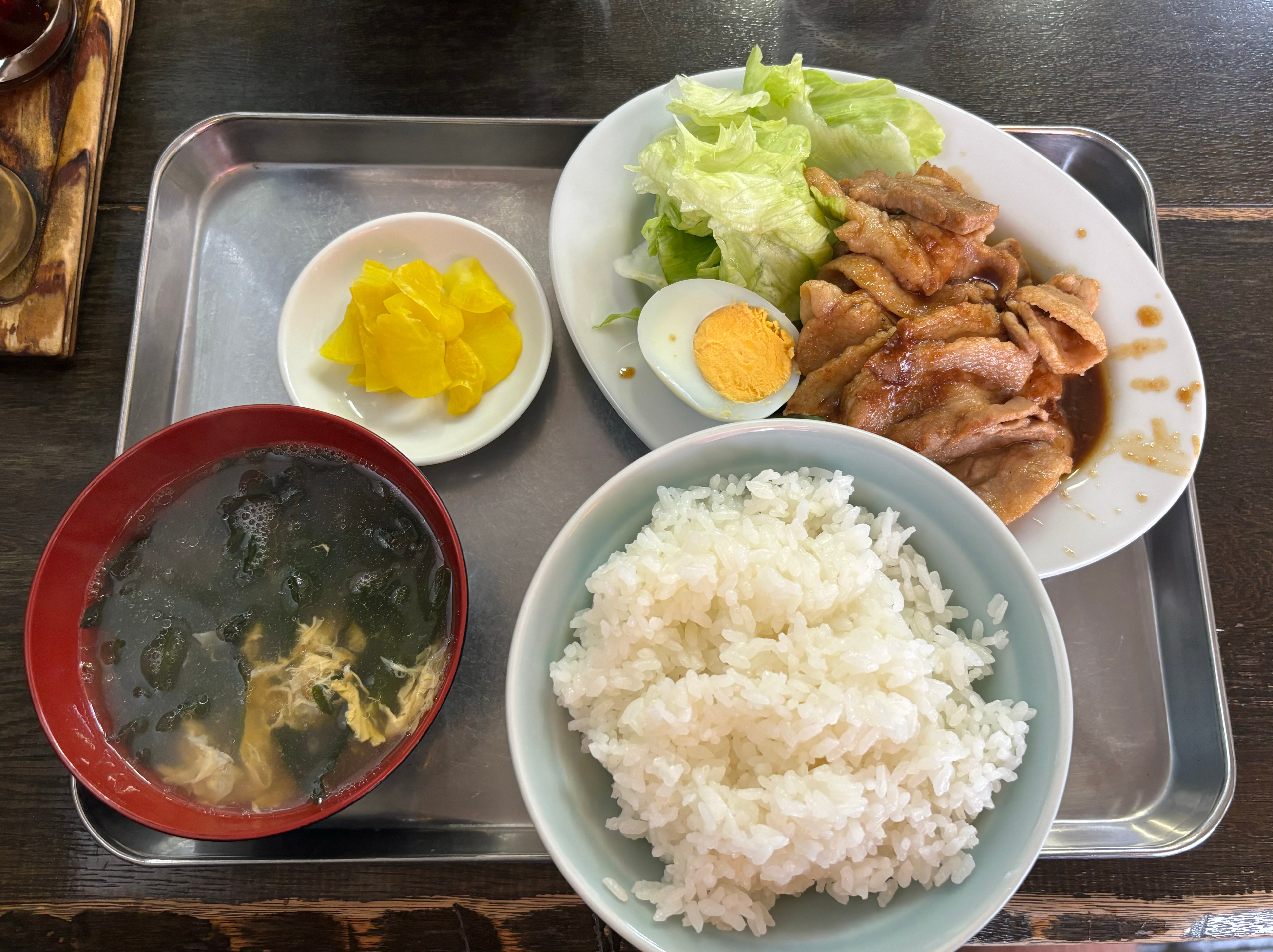
    The meat set meal consisted of rice, really flavorful and well seasoned pork and half of a boiled egg, as well as some lettuce and pickled radish. 

    The meat was very tender and the set was only 750 yen. With the fried rice it was only 1300, so it is very much worth your penny.

    Oh yeah, every dish comes with an egg and seaweed soup for free which is a nice addition too!

    The third generation element is also something I find genuinely moving about Matsuba. Japan has a real succession crisis when it comes to small restaurants — so many great places close not because the food got worse but simply because nobody was willing or able to take over. S

    eeing a daughter step in alongside her mother to keep something her grandfather started going is the kind of thing that makes you want to go out of your way to support it. And the fact that the food is also legitimately good makes it even easier to justify.

    The fried rice alone, with its generous pork and shredded egg, is something I would go back for on its own. But it is the combination of the history on the walls, the family behind the counter, and the honest home-style cooking that makes Matsuba one of my favourite posts on this entire blog.

    This is a very good Japanese style Chinese restaurant in Tokyo that has a really unique history, so If you have the chance I highly recommend it!

    Thanks for reading – if you’d like to support and follow along: 

    More about me

    Different types of ordering systems in Japan explained

    Purchasing an onigiri to keep me fuelled throughout my journey 🍙

    Planning a trip to Japan? This may help: 

    🏨 Find a hotel in the area — Booking.com

  • Rice Curry Manten – 45 Year Run Curry Shop In Jinbocho Area Tokyo!

    Must know Info:

    Rice Curry Manten – ライスカレー まんてん *Cash Only*

    〒101-0051 Tokyo, Chiyoda City, Kanda Jinbocho, 1 Chome−54

    4 minute walk from Jimbocho Station 

    Hours (as of 2026/03): Monday – Saturday 11am-8pm

    Order system: Call Out System

    Manten is a super popular, fast-serving curry shop located in the Jinbocho area of Tokyo. 

    I went in 2024, and while popular it has seemed to increase in popularity significantly since then, so I am unaware of how the business of the place is but when I went around lunch time on a weekday I was able to enter without lining up. 

    Jinbocho is a big business area, as well as has a few university campuses, so the clientele are reflective of it – a tell tale sign that it has been able to stay in business for 45 years. 

    It is a simple menu with, you guessed it, curry. There are a few different renditions of it, some plain, and others with pork-katsu or wieners, but they are all mix and match  – so is the size. 

    I was unaware of this because it isn’t written on the menu, but you will see that with a lot of local shops like this they allow little changes like this, so it always helps to ask. 

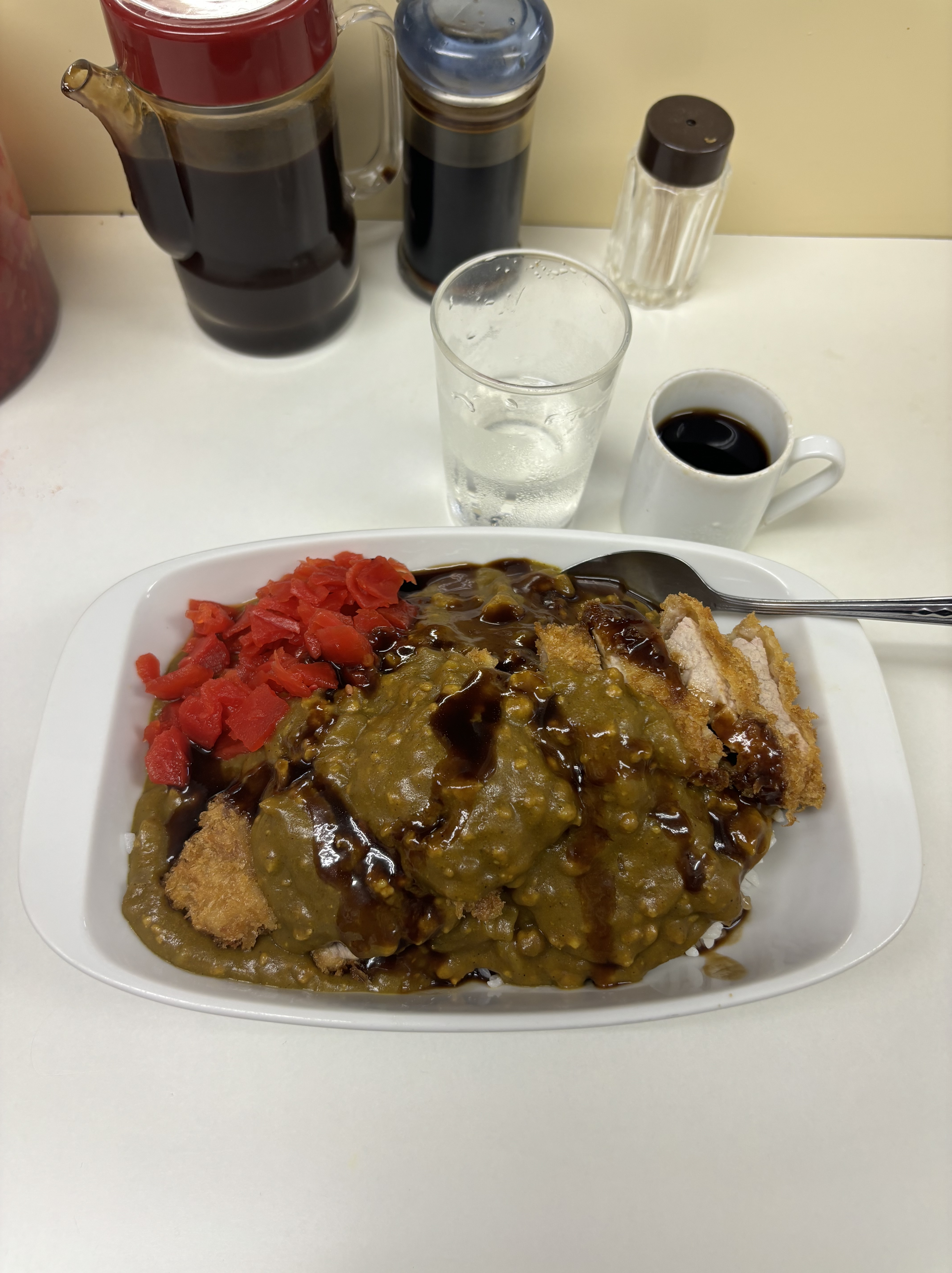
    I personally got the katsu-curry and I upgraded the size to “oomori” or large for free of charge. They have a size beyond this which is “megamori” and is supposedly 3 times the size, so next time I go I think I am going to have this. 

    The curry was just how I liked it, not too thick and not too soupy. You were able to taste the potato and onion that was mixed into it, and I like that because it doesn’t mean you are simply tasting curry, but you also get the heartiness from the potato and sweetness of the onion mixed in too.

    The amount they served was generous and it was enough to cover all of the rice which is often not the case at a lot of curry places – especially for how cheap it is! 

    At the time I went, the katsu-curry was only 700 yen, and I don’t see it having gone up much, if at all. 

    The katsu was cooked perfectly, and the crispy pork mixed with curry is truly a match made in heaven and I wish I could shake the hand of whoever came up with it. 

    The red things on the dish were Japanese tsukemono (sweet-pickled vegetable things) and they add a nice bit of crunch and the sweetness helps offset the little bit of spice that the curry has. 

    They had a few different sauces as well, but all of them were a little sweet and paired amazingly with the curry – I stayed conservative but I could have easily drenched it in it, it was that good.

    Lastly, and something I have never seen elsewhere is that with every order they give you both water and a little cup of black coffee (I guess this is a tradition that started with all the workers coming in). Surprisingly however, the bitterness of the coffee and richness of the curry actually go quite well together, and I have read that coffee powder is sometimes used as a secret ingredient in curry to enhance the flavour. 

    The inside of the shop were all counter seats, and you kind of sit in a half circle with the chef(s) in the middle serving your food. 

    When you sit down you say your order, and when you leave you pay, all from the same spot, and to the same people who handed you your food.

    It is an efficient system, and even better food. It makes complete sense that it is as popular as it is, and honestly? I am kind of glad it has gotten the recognition it deserves (though it may make  it longer to get in as compared to how it was before). 

    Thanks for reading – if you’d like to support and follow along: 

    More about me

    Different types of ordering systems in Japan explained

    Purchasing an onigiri to keep me fuelled throughout my journey 🍙

    Planning a trip to Japan? This may help: 

    🏨 Find a hotel in the area — Booking.com

  • Shirahamaya – Incredible Seafood Restaurant Right Beside The Ocean In Itoshima!

    Must know Info:

    Shirahamaya – 浜焼き白浜家 *Cash or Card*

    677-2 Shimakeya, Itoshima, Fukuoka 819-1335, Japan

    4 minute walk from Keya Bus Station (Itoshima)

    Hours (as of 2026/03): Monday – Friday 11am-9pm, Saturday-Sunday 11am-10pm

    Order system: Menu

    Located on the far edge of Itoshima by the water, this shop is by no means the easiest to get to, but it is well worth it if you are in the area. 

    I highly recommend Itoshima for its beautiful beaches and views, and even though I was staying in the city centre in Fukuoka, with a few buses I was able to get here pretty painlessly. But do be aware that around this restaurant there are no drug stores or grocery stores of that kind so pack accordingly! 

    Shirahamaya opened in 2018 in the Keya Fishing Port, and they are one of the few restaurants around here.

    It is a big open style restaurant with high ceilings and big windows open to the ocean giving it lots of natural light. 

    There are quite a few tables that stretch over the course of the restaurant and each one has their own little grill, which you can use to cook your own seafood on

    They also have seating outside with umbrellas, but it was like 40 degrees when I was there so it was a no go lol. 

    They have a big menu, and it all consists of freshly caught seafood, all of which (or at least most) caught right next door to them at the fishing port – It doesn’t get fresher than this! 

    They have your stereotypical sashimi, as well as some more out there fish like squid and they also have a lot of fried foods as well, like oyster-fry for example which is really popular in Japan and often served with a rich tartar sauce – I highly recommend it. 

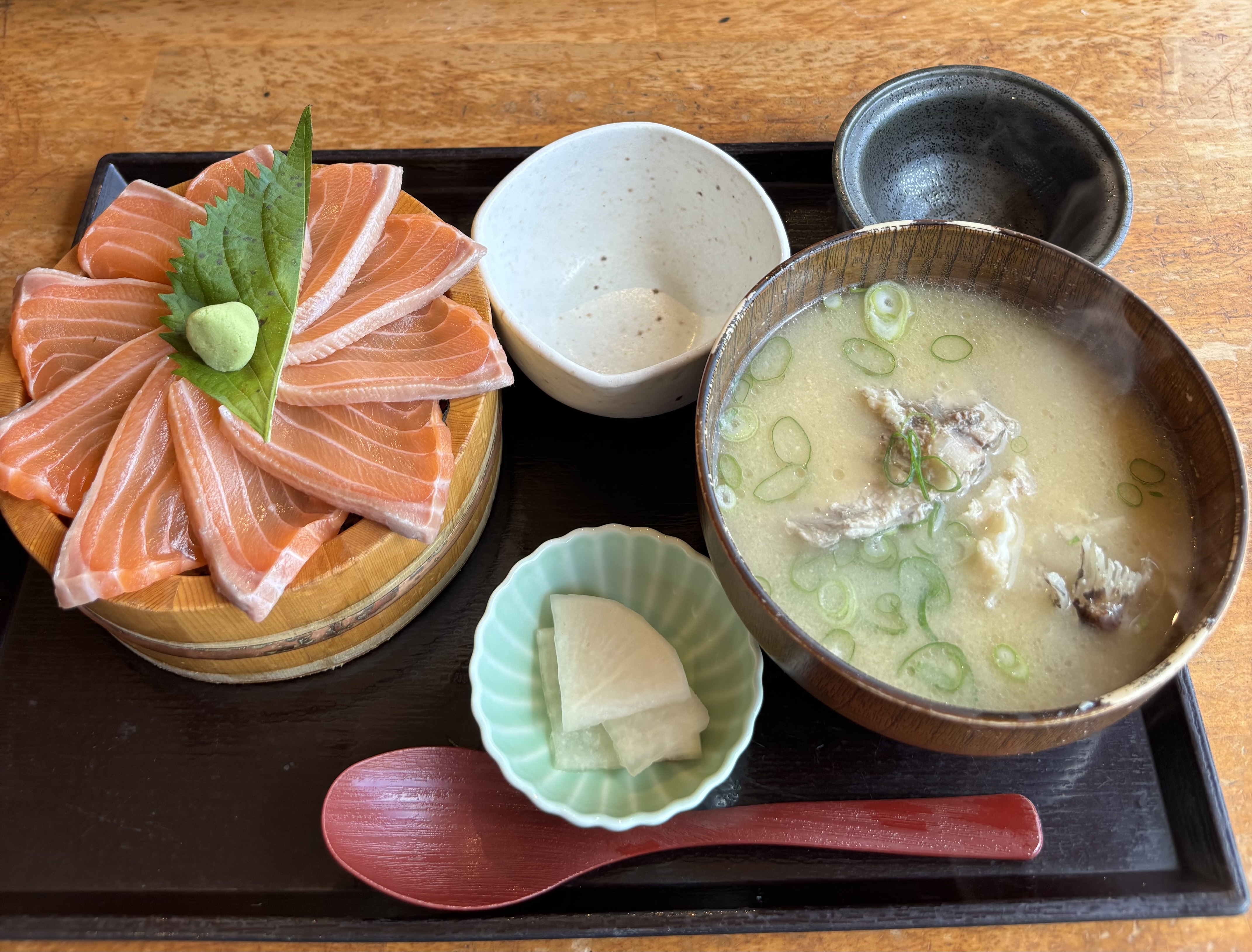
    They also had various kaisendon (seafood over rice essentially) and I got the salmon one which came with a very rich miso soup packed with fish in it that just slid off the bone.

    The salmon was excellent quality and was incredibly tender – this matched with the piping hot rice underneath wonderfully. 

    But what stands out the most for them is the aforementioned grills and the fact that you can cook it in front of you without even getting up from your table. 

    It is very similar to Yakiniku in a sense, except with the fish, you have to let them sit for a lot longer and don’t need to move them around as much as you would with meat (so actually a lot less work I would say). 

    What I got were the scallops, and probably some of the biggest ones I have ever seen. They put the whole shell down onto the grill, and as it cooks the top piece will slowly begin to open up. 

    Then, once it is finished cooking they give you some butter to put directly into the shell, and with this I put some soy sauce too. 

    Let me tell you it was insane how good this was. The juice from the scallop mixed with the richness of butter and umami from the soy sauce is getting my mouth watering just thinking about it. 

    And as for the scallop itself, it was super plump, yet had no overly fishy taste to it – almost as if they had caught it a few minutes before placing it on my table’s grill. 

    Though it is such a seemingly simple thing to make, it is the quality of the fish, and perhaps the fact that you are surrounded by the ocean that elevates it that much more. 

    Oh, and it also looks like they have all you can eat seafood courses as well, so If I go back I know what I will be having!

    Regardless, all the seafood here was incredible, so if you come down here then be sure to check it out!

    Thanks for reading – if you’d like to support and follow along: 

    More about me

    Different types of ordering systems in Japan explained

    Purchasing an onigiri to keep me fuelled throughout my journey 🍙

    Planning a trip to Japan? These may help: 

    🗺 Find a food tour near this restaurant — Viator

    🏨 Find a hotel in the area — Booking.com

  • Majiya – Fun Insanely Cheap Okinawa Themed Izakaya In Fukuoka!

    Must know Info:

    Kaientai Okinawa Majiya Daimyo – 海援隊沖縄 本気や 大名店*Cash or Card*

    1 Chome-3-4 Daimyo, Chuo Ward, Fukuoka, 810-0041, Japan

    10 minute walk from Tenjin-Minami Station

    Hours (as of 2026/03): 5-11pm everyday

    Order system: Menu

    This is a fun one if you are wanting to get some drinks in a lively environment right in the centre of Tenjin Fukuoka.

    Tenjin has a ton of shops and restaurants, and it also gets very lively at night. Around this area there are quite a few izakaya (japanese bar/restaraunt), but a lot of the ones I found were generic chain places you could find anywhere else in Japan. 

    I would have been fine with that, but A they were packed with people, and B, after I found “majiya” I knew it would be a good place to grab a drink. 

    Now, based on what I just said here I might sound a bit like a hypocrite, but majiya does not serve food from Fukuoka, instead, they are completely Okinawan themed, from the food all the way to the atmosphere of the place as well. 

    But hey, I figured even if it wasn’t serving some local specialties, it was still a “local” restaurant, so after waiting around an hour and wandering around I went in. 

    Keep in mind that depending on the day you go it can get super busy (especially the weekends) and the staff do lack a bit of attentiveness to those that enter in the door because they are so busy with other things, so the best you can do is catch their attention and have them take your name down. From here they will give you an estimated time to show back up at, but I would show up a bit before they tell you in the chance they think you might be a no show/seats open up early. 

    As for the vibe, it is a wide area with seating all over the place – tables, bar seating, and it extends to the second floor. 

    Izakaya’s, or places where people drink in Japan can be like a whole different country in the sense that people let go of the societal constraints and pressure they have on them. This is why it is much easier to make Japanese friends drinking than it may be elsewhere. 

    Regardless of this however, this izakaya had exactly that. People drinking, eating, and enjoying themselves conversing with their friends etc. 

    The drinks were standard, beer, high-ball, and the list goes on, but one thing that was cool was that they had a lot of fruit-themed drinks, I guess to stick to the Okinawan vibe. 

    As for the food though, this is where I was quite impressed. 

    A lot of Izakaya’s in Japan (especially cheap ones) tend to have the same things. French fries, maybe some yakitori, etc. and while this was the same here, they also had a lot of traditional Okinawan dishes like bitter melon pork stir-fry for example.

    I thought it was cool to be able to have these at a cheap price without having to visit Okinawa (though I highly recommend you do if you have the chance). 

    Other than that, this place was ridiculously cheap, almost to the point where I question if they aren’t in a minus for their sales constantly. 

    For example, if you go with an all-you-can-drink option, you can have 2 hours of it for only 1078 yen. That is like 9 dollars Canadian and even less American. Or, if you just want to order each drink individually, for those of you beer drinkers, the first hour after going into the restaurant you can get a glass of beer for only 110 yen (like 1 dollar) as many times as you want. It seems too good to be true, but it actually is, and there happen to be a lot of places like this in Japan.

    While this wasn’t the best food I have ever had in Japan, actually far from it, it was solid, and a good place to hang out off the beat and track a little bit. If you are in a pinch on where to go around this area I would highly recommend it!

    Thanks for reading – if you’d like to support and follow along: 

    More about me

    Different types of ordering systems in Japan explained

    Purchasing an onigiri to keep me fuelled throughout my journey 🍙

    Planning a trip to Japan? These may help: 

    🗺 Find a food tour near this restaurant — Viator

    🏨 Find a hotel in the area — Booking.com

  • Hakata Issou Honten – Incredibly Good And Popular Tonkotsu Ramen Shop In Hakata!

    Must know Info:

    Hakata Issou Honten – 博多一双 博多駅東本店 *Cash Only*

    3 Chome-1-6 Hakataekihigashi, Hakata Ward, Fukuoka, 812-0013, Japan

    7 minute walk from Hakata Station

    Hours (as of 2026/02): 11am-12am everyday

    Order system: Ticket System

    Perhaps the longest I have lined up for any restaurant throughout my time in Japan was this uber-popular Tonkotsu ramen shop in Fukuoka, “Hakata Issou Honten”. 

    Being that tokotsu ramen, or pork-bone broth ramen has its origins here, it is a no-brainer that if people come they are going to eat it, and this restaurant happens to be the most popular, or at least most widely recognizable. 

    It is a small shop, with only about 10 counter seats and 3 ish tables, but they do have a fast turnaround, it is just that the sheer volume of people lining up overtakes this significantly. 

    When I went it was near the end of July, so it is a peak time for travelling and I think that this definitely had something to do with it, but I think I lined up for over an hour, and I will warn you that there isn’t much shade, so this paired with the heat of the summer felt like I was in a sauna lol. But it was worth it!

    Once I got up to the end of the line, the staff started directing people to go and purchase their food tickets before heading back to the line so if there is a line just wait until they call you in. If you are lucky and there is no line then I would go up and purchase it right away! 

    Ok, now to the main part I am sure you all have been waiting for – the food, and let me tell you it was amazing. 

    As I mentioned, tonkotsu ramen originated in Fukuoka, and it is the same style of ramen that Ichiran Ramen serves (though I have never been there). Also – a side note: there are way better ramen shops that are a lot less busy and cheaper than Ichiran so please try going to them (use this website for reference if you need!). 

    I will get it out of the way now, but tonkotsu ramen is rich. I might even go as far as to say that it is the richest ramen soup you can have in Japan (but don’t quote me on it!) 

    Because of this some people might not like it, but I personally loved it, and though I felt like I needed a gallon of water afterwards it was completely worth it. Keep in mind, this was also with me eating it in 35C+ weather, so I can imagine this taste would be empathized even further if eaten in the colder months. 

    Regardless, the soup is while rich, not overly salty, and it completely captured all of the umami from the heaps of pork bones that are being simmered down for hours before it’s served. 

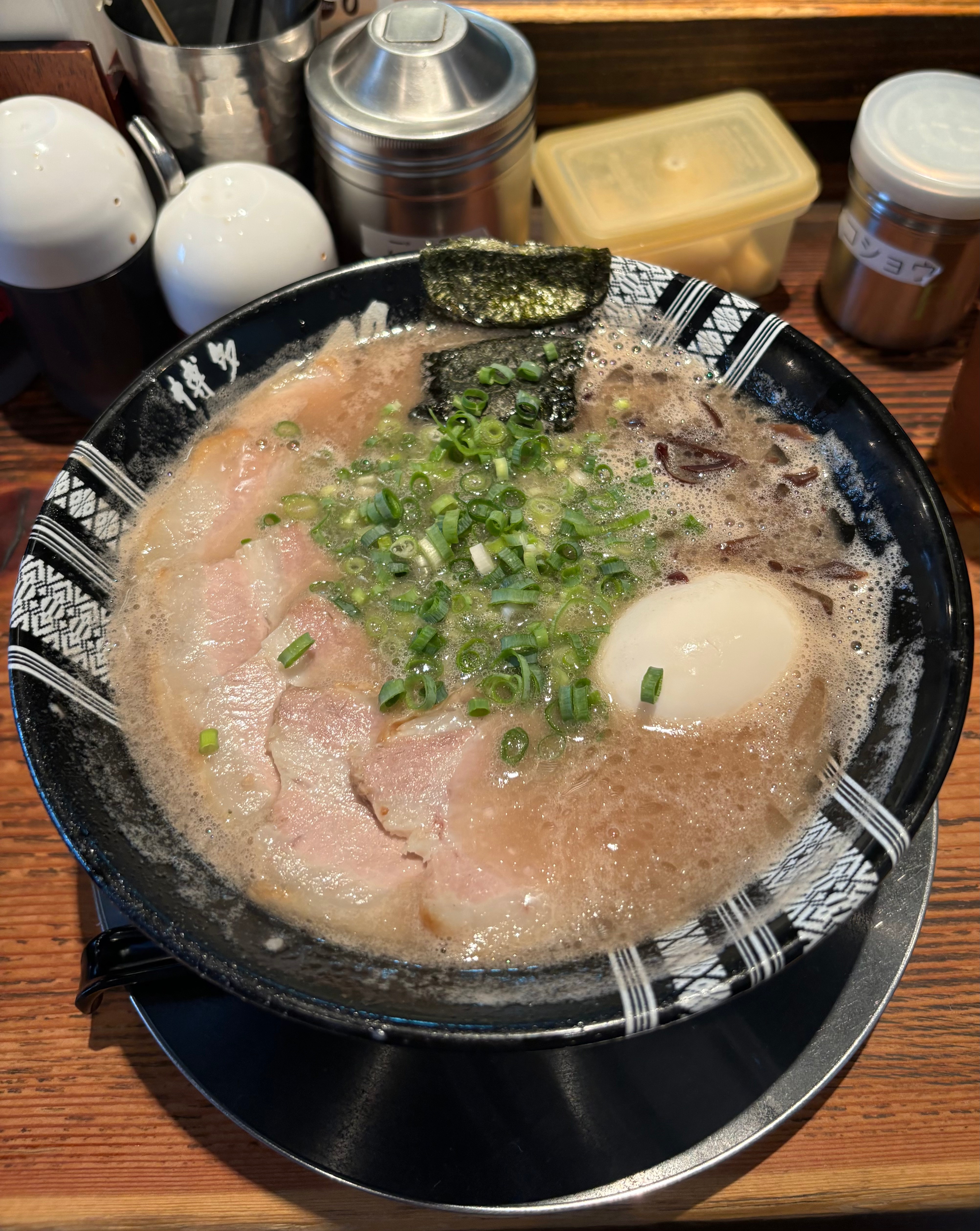
    It is garnished with finely cut green onions and seaweed, kikurage or black ear mushroom (don’t worry, it really only adds a little bit of a crunch and isn’t a very strong flavor for those that don’t like mushrooms), a perfectly cooked egg, and chashu pork – all making for a rather simple, yet perfected bowl of ramen with all of the ingredients acting harmoniously together. 

    The noodles, which is a very identifiable factor in this ramen, is both how thin they are, as well as the fact that you can choose how hard you want them. I recommend “barikata” which means very hard and makes them almost a little el dente. 

    Aside from this, I got a bowl of rice, which I will likely write in every single one of my ramen posts, but especially with those that have a strong soup broth like this, I think that it is absolutely necessary (of course if your stomach is able to fit it in). 

    But for me, after waiting over an hour in the heat It got me extra hungry and so to replenish the amount of weight I lost in sweat I also ordered the “makanai bowl” which was an amalgamation of a bunch of different ingredients like egg, some canned tuna mixed with mayonnaise, more mayonnaise just on its own, chashu, green onions and a few other things. It was very good, and felt like something you would throw together with whatever ingredients you have laying around your house. 

    This brings me to my next point, because “makanai” is a term used describing when someone will eat food from their workplace on their break, and so my thought process is that the restaurant turned this into an actual menu item because the staff ate it so much. 

    While people may say that there are better places for tonkotsu in Fukuoka, and that this place is “too overrated” because there are always long line ups, I would say that it might be true. 

    But in terms of convenience with its proximity to the station, as well as how far they have perfected their craft, it speaks for why it is as popular as it is and I highly recommend you check it out!

    Thanks for reading – if you’d like to support and follow along: 

    More about me

    Different types of ordering systems in Japan explained

    Purchasing an onigiri to keep me fuelled throughout my journey 🍙

    Planning a trip to Japan? These may help: 

    🗺 Find a food tour near this restaurant — Viator

    🏨 Find a hotel in the area — Booking.com

  • Tetsunabe Gyoza – Crispy Gyoza Served On A Hot Iron Skillet In Fukuoka!

    Must know Info:

    Tetsunabe Gyoza – 博多 祇園 鉄なべ *Cash Only*

    2-20 Gionmachi, Hakata Ward, Fukuoka, 812-0038, Japan

    8 minute walk from Hakata Station

    Hours (as of 2026/02): Monday-Saturday 5-10:30pm

    Order system: Menu

    Tetsunabe Gyoza is as the name suggests quite famous for their famous local Fukuoka favourite gyoza, and actually, they were the first shop who created them too. 

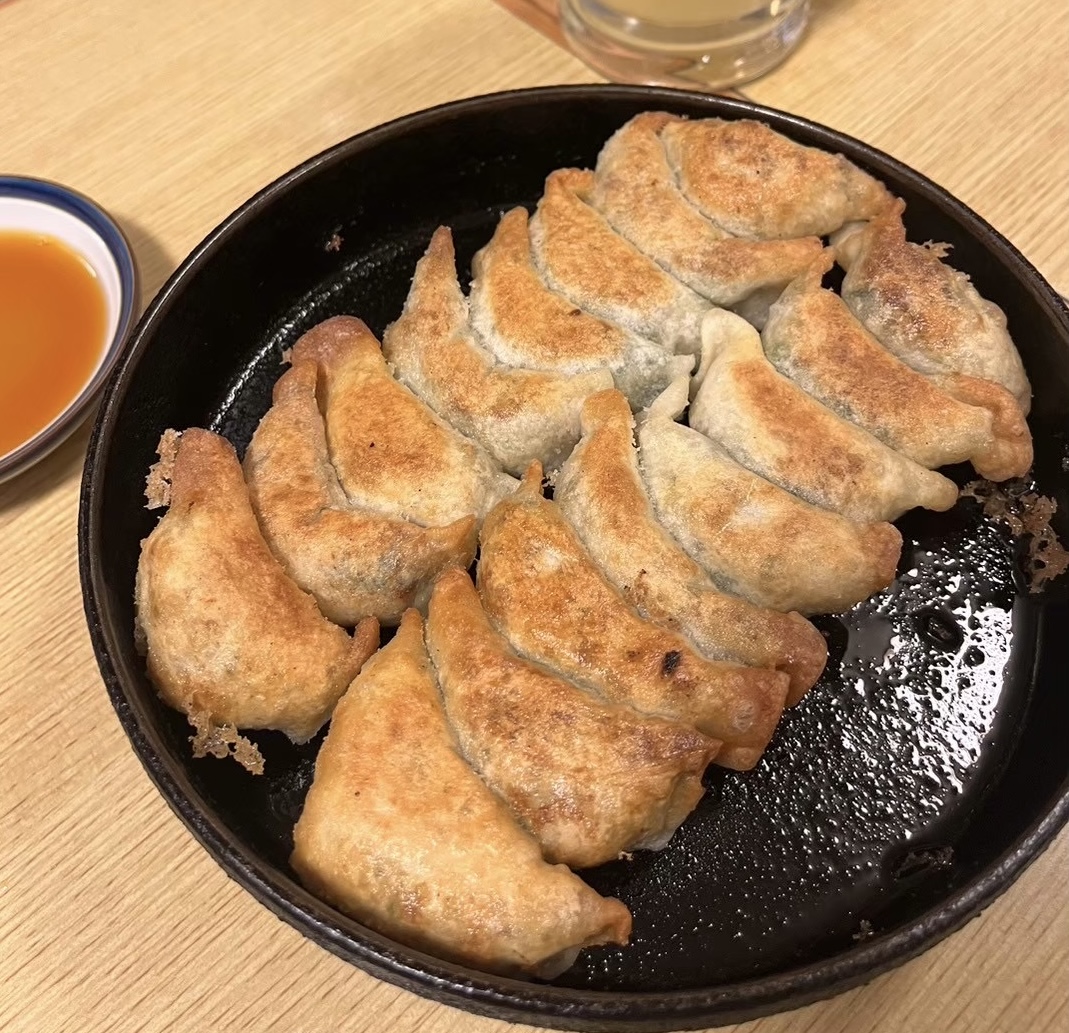
    What differs them from more traditional gyoza that are cooked over a stove top, these are cooked in a big iron plate, which in Japanese is “testsunabe”, as the name suggests. 

    Regardless of the size of gyoza you buy, they will bring this hot iron skillet to your table and you eat it from there. 

    One other thing that is unique about them is also the fact that they are all tiny bite sized pieces. 

    I am unsure of the reasoning for why they are as small as they are, but I have a feeling it might be because they are able to ram more into the skillet this way. 

    Regardless, they are super tasty, and because they are constantly cooking on the hot skillet, even after it is brought to your table, they get super crispy. 

    The filling for them seemed to be the same as your normal, traditional gyoza with pork and a few vegetables, but the actual gyoza paper itself was the star of the show. You could tell it was hand made, and was on a different level when compared to other run-of-the-mill ones you would buy elsewhere. 

    Besides this, I also ordered the potato salad and it was very good too. Potato salad is a must when you are drinking in Japan, as most places can never really get it wrong because it is so simple. 

    The restaurant itself was I would say an Izakaya, except the menu was limited and everyone was ordering the gyoza.

    It seemed that the shop had some sort of connection to the Japanese theater called “kabuki” because there were pictures hung up all over the shop, as well as other celebrities and such. 

    I would have taken a picture, but next to all the signage was a bunch of warning signs that you are not allowed to take pictures inside of it, so I refrained. But trust me when I say that it was COVERED in photos. 

    The customers seemed like there were a lot of locals, as well as some other people who had travelled to Fukuoka and knew of this place. 

    The inside of the shop had both tables and bar seating, and it was pretty big, but I still remember coming on a Saturday night at around 6 and waiting for maybe 30-45 minutes. 

    The kabuki connection is also something I think about whenever I recommend this place because it speaks to the kind of institution Tetsunabe has become in Fukuoka. It is not just a gyoza restaurant — it is a place where artists, locals, and travellers have all ended up at some point, and that mix of people gives it an energy that is hard to replicate.

    The no-photos rule inside is a bit unusual, but honestly I think it adds to it. You are there to eat and drink and be present, not to document it for later.

    And given that the gyoza are best eaten the moment they stop crisping on the skillet, that is probably the right call anyway.

    If you are spending time in Fukuoka and want one place that covers both the food and the atmosphere of the city, Tetsunabe Gyoza does it better than anywhere else I have been.

    If you want to get a casual drink in a cool shop, then Tetsunabe Gyoza is the perfect place I feel, especially since you can also knock off trying one of Fukuoka’s specialty dishes!

    Thanks for reading – if you’d like to support and follow along: 

    More about me

    Different types of ordering systems in Japan explained

    Purchasing an onigiri to keep me fuelled throughout my journey 🍙

    Planning a trip to Japan? These may help: 
    🗺 Find a food tour near this restaurant — Viator

    🏨 Find a hotel in the area — Booking.com

  • Motsu Nabe Ichifuji Hakata – Traditional Fukuoka “Motsu Nabe” in Hakata!

    Must know Info:

    Motsu Nabe Ichifuji Hakata – もつ鍋 一藤 博多店 *Cash or Card*

    2 Chome-4-16 Hakata Ekimae, Hakata Ward, Fukuoka, 812-0011, Japan

    3 minute walk from Hakata Station

    Hours (as of 2026/02): Sunday – Thursday 5-11pm, Friday and Saturday 5-11:30pm

    Order system: Menu/Set Course Booked Online

    Probably one of my favorite all time dishes in Japan, or at least in the top 10 for sure. 

    Motsu Nabe is probably the 2nd most recognizable dish in Fukuoka besides Tonkotsu Ramen, and it 100% exceeded the hype. 

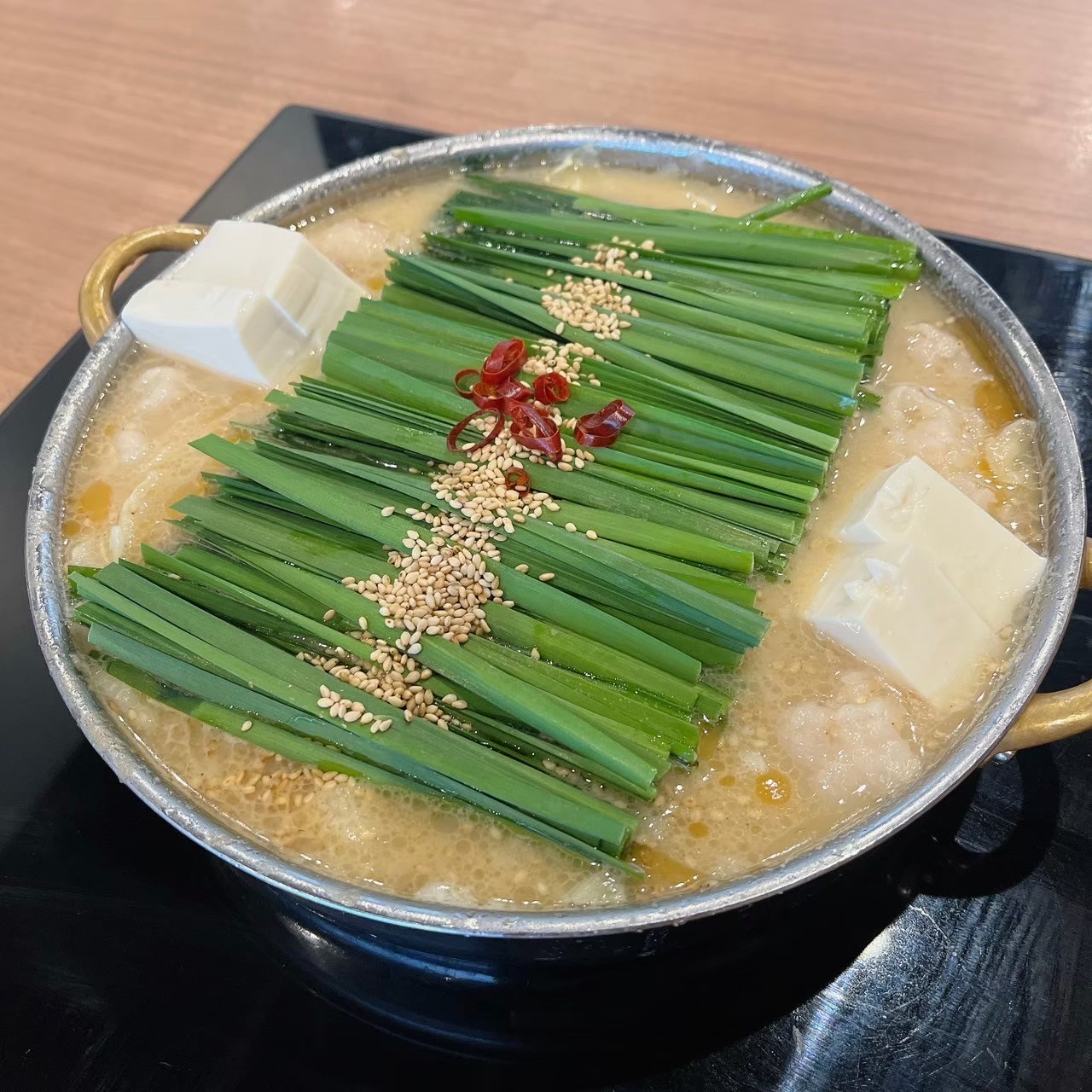
    Nabe is essentially Japanese hotpot, and motsunabe specifically is a soy sauce or miso soup base packed with beef or pork intestines, tofu, cabbage, and topped with chives that slowly get submerged into the soup. 

    Motsu Nabe Ichifuji is I think the most famous for this dish, though there are quite a few that one may consider more “local” but in terms of access and convenience this was the one I went with in the end. 

    Aside from it being close to the biggest station in Fukuoka (Hakata), they have a really easy reservation system you can book on their website (which they also have in English). 

    Because of this, I was able to book it in advance and secure one of their many course menus which I personally think is the best option if you want to try a bunch of their different dishes (just be warned that it is a lot of food and the motsunabe comes out last). 

    If you don’t care about waiting, then the restaurant has 3 floors and seating for 140 people, so there is a chance you might be able to get in and then just order off of the menu normally too. 

    For the course, I was with another person so we were able to share the soup, but with one person it might not be possible (unless you eat a ton, but even then I would tread on the passive side here). 

    The course I recall going with was the Taka course which has 7 dishes consisting of sashimi, a stew of some sort (served in a little bowl), basashi (horse meat sashimi), the motsunabe, and a dessert. 

    So yeah, you don’t have to worry about not getting enough food, nor about the quality of it, and this is all for only 4500 yen, so I feel it is an incredible deal. 

    The seafood was great, and so was the horse sashimi, which I know some of you may be thinking “there’s no way I’m eating that”, but trust me don’t knock it until you try it, because if I had the option to, I would be ordering it over most seafood sashimi. 

    There is no off taste to it, and it is very meaty and tender, maybe a little chewy? I don’t know how to describe it, but I highly recommend you try it. 

    Then, it was time for the main event, the motsunabe, and wow, I was absolutely blown away. 

    Usually when I go to different prefectures in Japan I almost always try the dishes they are most famous for, but sometimes they are just ok. 

    But this was different, the broth was creamy, the intestines were tender and packed with umami, and the vegetables and tofu soaked up the soup excellently. This was actually the dish that got me hooked on nabe and led me to buying my own hotplate in Japan too. 

    But by far, I just cannot forget the soup. It was like nothing I had ever had before, and if I could drink it everyday I would.

    Then, when I had finished all the ingredients in it thinking I would have to waste the rest of the soup, the staff brought over these thick udon-like noodles as a part of the course. I couldn’t have been happier at that moment. 

    My stomach on the other hand felt like it was going to explode, but I knew this wasn’t going to be a dish I would be able to have very often going forward, so I enjoyed every last bite. 

    My recommendation for finding a place is look on the Japanese food website “tabelog” and look for places that are a 3.5 rating or higher, because in the eyes of the Japanese, there is no perfect 5 restaurant, so even the best ones in Japan will be around a 4 ish a lot of the time. 

    If you come to Fukuoka then you must have this dish. But I do warn you, because if you have it at the beginning of your trip you may be disappointed with the rest of the food you have, but if you have it at the end, you will likely regret your decision not having it earlier, so pick your poison. 

    Oh, and there are shops that make it across Japan including Tokyo as well, but Fukuoka definitely is on a different level. 

    Thanks for reading – if you’d like to support and follow along: 

    More about me

    Different types of ordering systems in Japan explained

    Purchasing an onigiri to keep me fuelled throughout my journey 🍙

    Planning a trip to Japan? These may help: 

    🗺 Find a food tour near this restaurant — Viator

    🏨 Find a hotel in the area — Booking.com

  • Cafe Accueil Ebisu – Cozy Cafe With Great Food In Ebisu!

    Must know Info:

    Cafe Accueil Ebisu – カフェ アクイーユ 恵比寿店 *Cash or Card*

    Japan, 〒150-0021 Tokyo, Shibuya, Ebisunishi, 2 Chome−10−10 エレガンテヴィータ 1F

    5 minute walk from ebisu station 

    Hours (as of 2026/02): 11am-10pm everyday

    Order system: Menu

    Located in the rather classy area right between Daikanyama and Ebisu is this very popular cafe. 

    It seems that the general consensus for getting in here is making reservations, and this is because it is super popular among females. 

    But for me, I was able to get in without any wait, and on the weekend at that!

    I think one of the main reasons for this was that It was in the heat of the summer in July so maybe people weren’t wanting to leave their house as much, but I don’t know. 

    Regardless, the cafe was huge, with outdoor seating, seating inside on the first floor, and a whole huge second floor as well which was divided into two sections. 

    There were staff on both floors, and as with most restaurants in Japan, also very attentive. 

    Because of this I was able to order very quickly, and while most of the customers around me were ordering little slices of cake or something, I went all out and ordered the omurice and a big pancake. 

    Omurice is essentially the Japanese version of an egg omelet, and it is served on a lump of rice, which you then proceed to cut down the middle of the egg and it folds over said rice beautifully. 

    It is a simple dish, but extremely hard to make perfect, and this one was perfect. 

    It had the perfect amount of runny egg in the middle that I quite so often desire due to my lacking egg cooking abilities, and to top it off, they threw a bunch of demi-glace sauce on it. 

    Omurice you will see served at traditional mom and pop shops generally just have a bit of ketchup, but this one pairing the creamy egg with the rich sauce was a bite made in heaven. 

    As for the pancake, it was also delicious. 

    It was thick to say the least, and I would go as far as to say it had more of a cake consistency to it, but all while maintaining the softness of a pancake. 

    They gave two decently sized pieces of butter which is something I only just realised recently is a must on pancakes, and a thing of syrup on the side (unfortunately they portioned it out unlike going to ihop or something, but it was good quality nonetheless!)

    I think what sets Accueil apart from a lot of the cafes that have become popular in the Shibuya and Daikanyama area is that the food is genuinely the focus.

    A lot of places in this part of Tokyo are beautiful to look at and photograph but leave you feeling a bit underwhelmed when the bill comes. Accueil is the opposite — the interior is nice without being overdone, the service is attentive without being intrusive, and the omurice alone is worth making a trip across the city for.

    It is also just a really comfortable place to sit for an hour, which in a neighbourhood as busy as this is rarer than you would think.

    If you are coming from Ebisu station and turn the wrong way out of the exit, you could easily spend an entire afternoon in this pocket of Tokyo without realising how much time has passed.

    While I wanted to try a few more of the items, my stomach could only handle so much, so I will have to wait until next time. 

    Overall, a really good place to stop by and relax for some good food. 

    While you might be recommended to make reservations, If you don’t care about where you sit, or if you have the patience to potentially wait then there are no issues with just showing up. 

    I would highly recommend coming here as while it is close to Shibuya, it is just far enough away to escape the hustle and bustle. 

    Thanks for reading – if you’d like to support and follow along: 

    More about me

    Different types of ordering systems in Japan explained

    Purchasing an onigiri to keep me fuelled throughout my journey 🍙

    Planning a trip to Japan? These may help: 

    🗺 Find a food tour near this restaurant — Viator

    🏨 Find a hotel in the area — Booking.com