Must know Info:
Yayoi Ken Roku Go Ten – 弥生軒 *Cash Only*
2-4-3 Honmachi, Abiko City, Chiba Prefecture JR Abiko Station Platforms 1 and 2
Inside of Abiko Station
Hours (as of 2025/12): Monday through Friday 7am-11pm, Saturday 7am-9pm, Sunday 7am-8pm
Order system: Ticket Machine
Now, I want to preface that this isn’t necessarily a post saying you have to go to this specific train-platform located restaurant, but if you have the time and don’t mind getting on a decently long train, then I think this the perfect place.
It is pretty far from central Tokyo, and there is really nothing to do where it is located lol…I know this from experience too, because I literally got on a train just to go and eat here, and when I finished I got on the train going the opposite direction from the same platform.
But I digress. One of the things that makes these a cool thing to experience is that they are not as common as they used to be, and can only be found at a handful of stations in Tokyo.
Another thing that’s unique about them is that they almost never have chairs at it, and the same goes for Yayoi Ken here.
What this means is you take your food once it is served from the register area, bring it to the counter to eat standing up, and bring the bowl back when you are done.
This is called ”tachi-gui” or just simply eating while standing up, and it is commonly associated with shops that serve soba or udon. This was a form of eating Japan came up with to cater to busy workers who need to get in and get out of the restaurant quickly.
While it is a bit of a gimmick in some forms, it is an important part of Japanese food’s culture, and the places that have this are now few and far between so I think everyone should try eating there at least once because you can get the true overworked Japanese business person experience!
This is just me joking (only partly), and despite Yayoi’s fast turnover of customers, they still manage to frequently have line ups. This is because they do something different from normal train-platform restaurants.
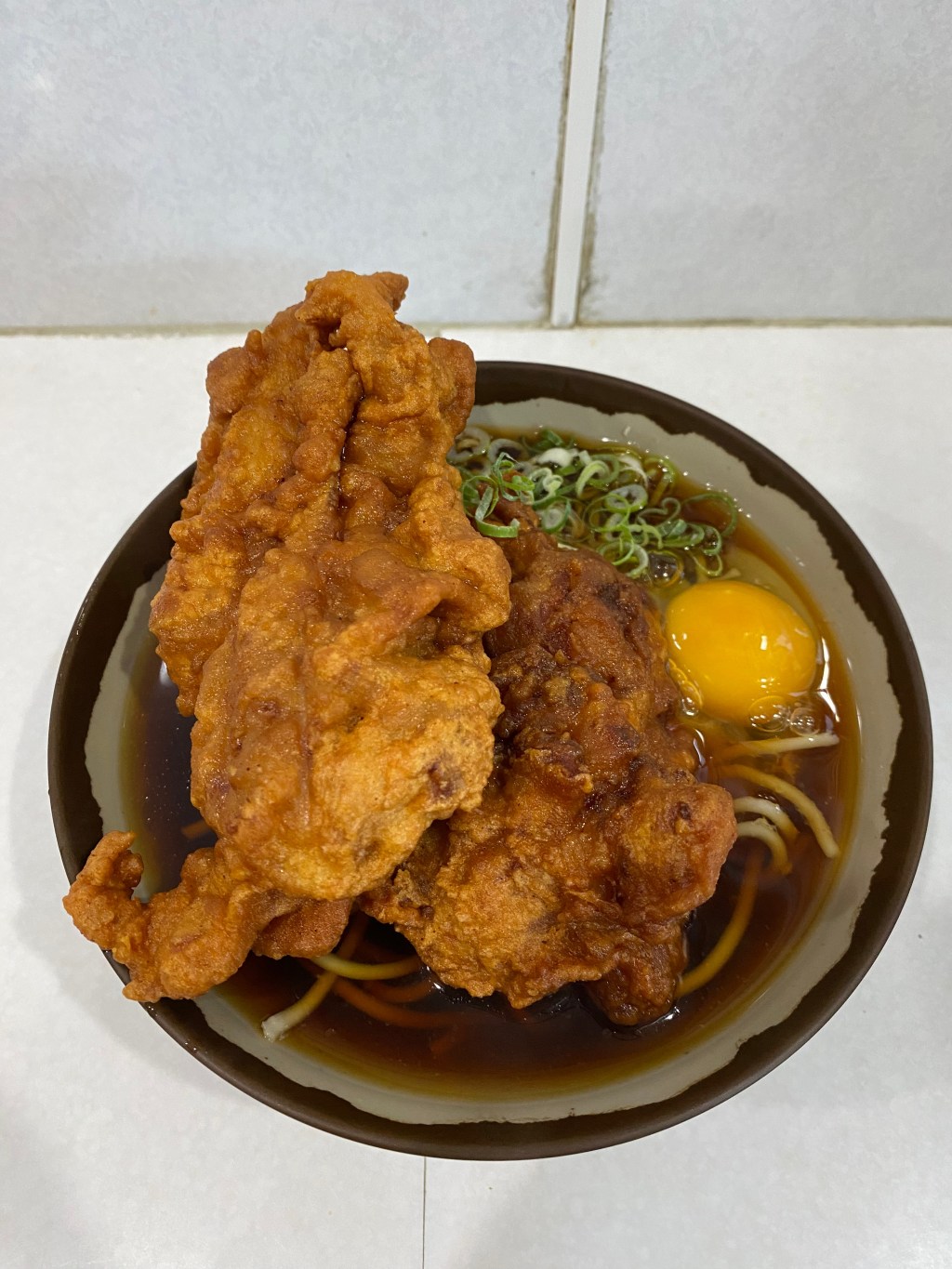
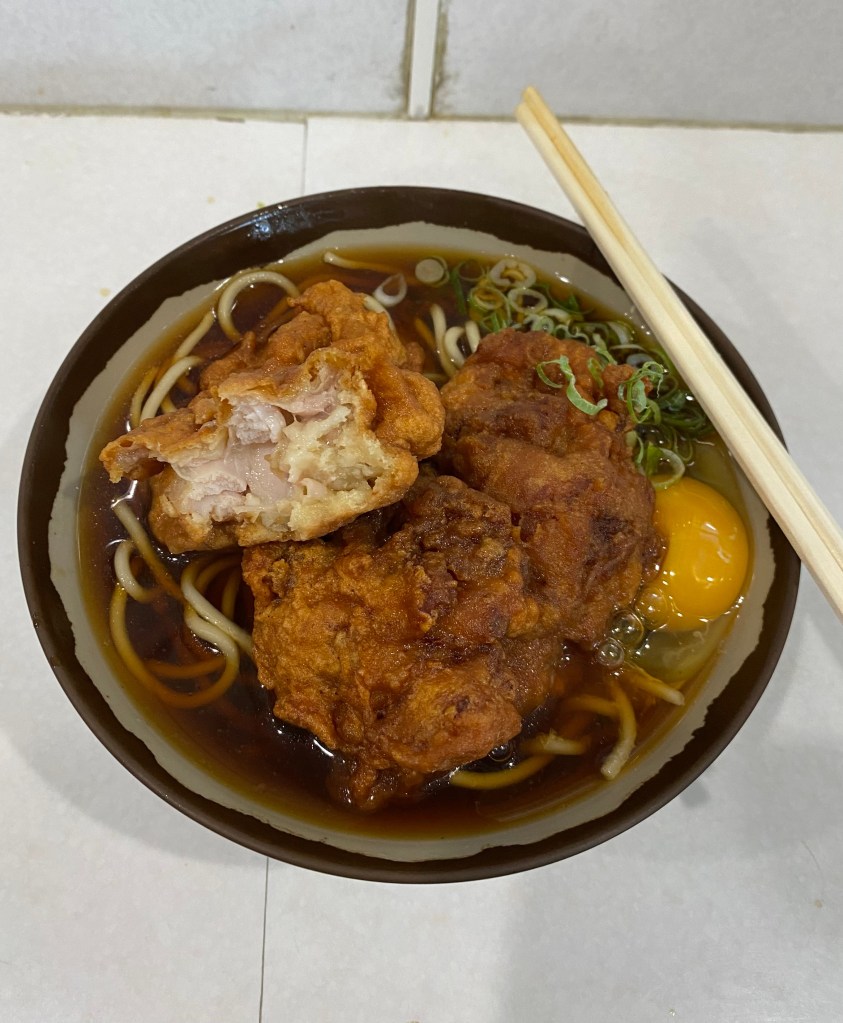
While they are still a soba restaurant, they put 2 pieces of huge, juicy karaage on top of it.
Why did this come about? I don’t know, but it is unique and why not put a fried food on top of a rather healthy one?
Maybe it’s the sort of un-written rule that soba should stay plain without any outrageous toppings, and having this sort of taboo is what makes it popular – it breaks away from the norm.
Regardless, the chicken was huge, and really tender. The only thing I want to mention is that regardless of if you get your soba cold or hot, the karaage is naturally going to lose its crunch as it is slightly submerged in the soup – so be aware of this.
Other than that, it is extremely cheap. Literally one bowl with two big pieces of karaage is 660 yen. It doesn’t even make sense, and I question that some of these restaurant sales are not in the red.
Overall, this isn’t a place I would say to drop everything to go to, especially if you are not in Japan for a long time. But, being that this is the “6th restaurant”, they have 3 other restaurants with one labeled without a number, one with a number 5, and one with a number 8…Why it is all over the place like this I don’t know! But at the very least they are all in the same proximity in Abiko City.
If you have the chance, I would say it is worth it 100% because truthfully, I don‘t know how much longer restaurants of this kind are going to be open for, despite it having such a deep history in Japanese society.
Thanks for reading – if you’d like to support and follow along:
Different types of ordering systems in Japan explained
Purchasing an onigiri to keep me fuelled throughout my journey 🍙
 LocalEatsJapan
Leave a comment