Must know Info:
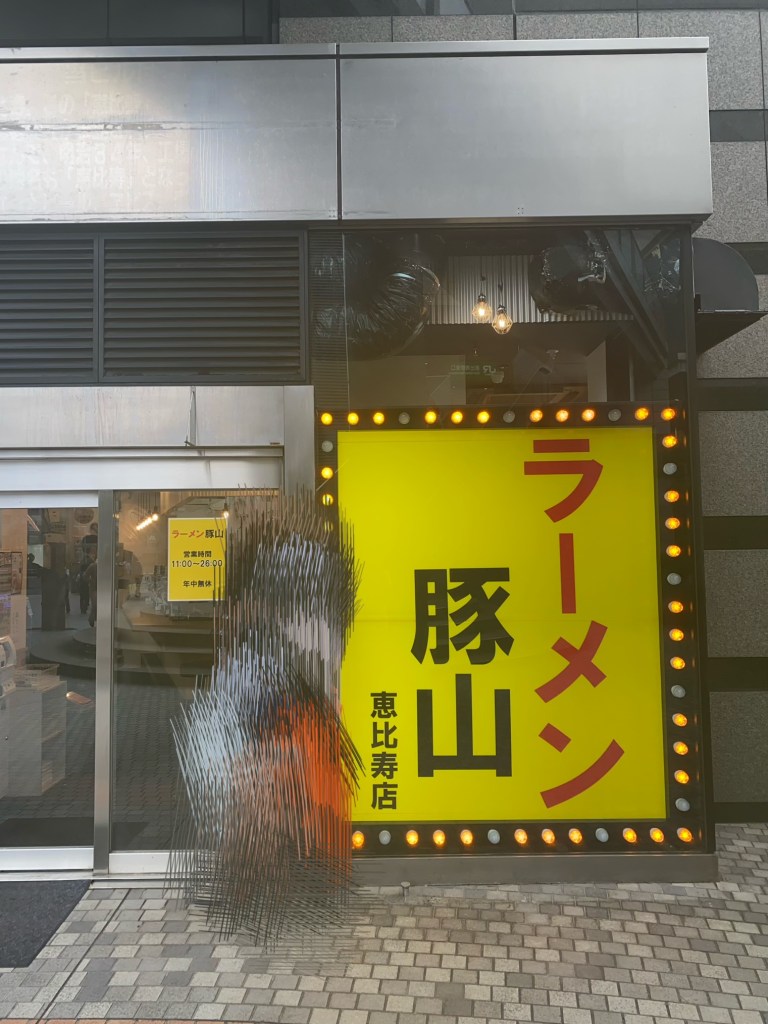
Buta-Yama – ラーメン豚山 *Cash only, some locations take Card*
Multiple locations nation-wide
Hours (as of 2025/12): Check the specific shops page on google maps
Order system: Ticket machine (electronic or non-electronic depending on shop)
While this isn’t necessarily “local” in the sense that it is a chain restaurant and you can find them all across Japan by their very bright yellow signs, it is a very “local” in regards to the fact that really only Japanese eat here.
The genre is called “Jiro-kei” and I am sure you may have seen some videos on it as it has been picking up speed on social media with influencers and the like posting about it, but I would go as far as to say that it has the biggest cult following out of any food in Japan.
They are mostly famous for their ridiculous portion sizes, and often strict rules. Some independent shops will even make you give them a 10000 yen bill and ONLY if you finish the whole bowl of ramen do you get it back. Yeah, some of them are hardcore.
This can be the same with the original chain of jiro-kei shops. Boasting a yellow, super basic sign, they have quite a few locations across the country, yet they all slightly vary in their rules and taste – this is what makes it difficult to dine at them and I myself have never been to them for this reason.
A lot of these times these shops can be quite unclean on the inside, and the staff can be quite rude as well. But this is yet another reason why it’s popular… maybe because it is the complete opposite of Japanese society and people like the breath of fresh air it brings?
Regardless, what you see the majority of influencers and bloggers posting, are these exact restaurants – the original bunch.
But what makes buta-yama different is that while still keeping the same style of ramen (and at high quality for it being a chain!) It is the complete opposite of the majority of jiro-kei restaurants in Japan with it being clean, easy to enter, with really simple rules, and with newer shops even boasting an electronic order panel which you can see the picture of the food you are ordering.
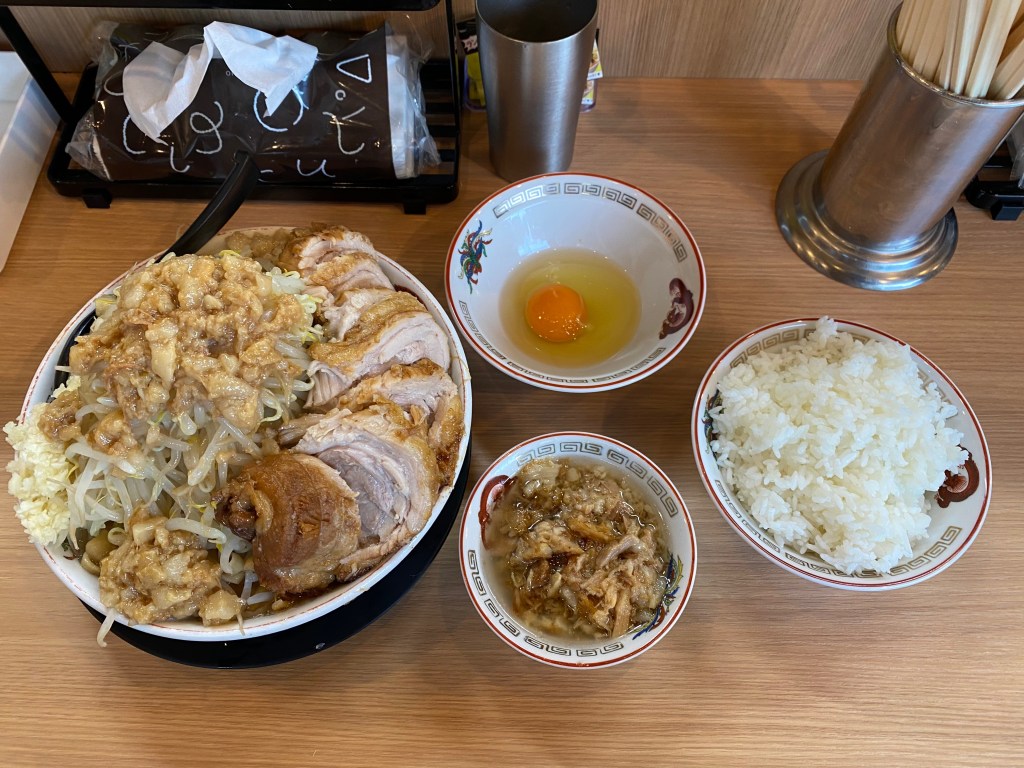
Buta-yama, quite literally meaning “pork mountain” is the main selling point here, as you can choose anywhere from zero up to 8 tender, but extremely thick pieces of pork.
Additionally, there is generally a mountain of bean sprouts, tons of raw chopped garlic, and the slop looking thing on top of the bowl in the picture, “back fat” (trust me it tastes better than it sounds).
As for the noodles, they are thick and done al dente, though you will only reach them after you have eaten some of the bean sprouts, and then you kind of grab the hidden noodles and pull them to the surface. This seems to be the golden standard for eating it.
The flavor was great to be honest, but this was only for the first portion because I overestimated how much I could eat and even though the ramen alone was enough to feed a small family of 4, I also made the mistake of ordering rice, extra back-fat, and a raw egg (which is sort of an advanced technique among the frequenters of jiro-kei shops where you dip your noodles in it after stirring it up, like sukiyaki).
While I finished it, I had to sit down on a set of stairs near the restaurant to reflect on the gluttony I just partook in. I have been back since and to other restaurants of the same style, but I have made sure to order what I know I can eat – this is the main thing I want to preface here.
Another thing to note is that everything is self-serve: water, aprons if you need it, chopsticks. One nice thing about Buta-yama as well is that at the location in Ebisu I went to, they had a water tap at the counter so you don’t have to worry about getting up.
Lastly, and the one caveat about jiro-kei is that there is a “call-system” which can be difficult even for Native Japanese speakers. While ordering is all fine and dandy because it can be done at a machine, the staff are going to ask you at some point before your food comes “what are your preferences?”
While slightly vague, a lot of stores (including Buta-Yama) now have little signs showing you what they consist of, but they are generally the quantity of “yasai” (beansprouts), “abura” (back-fat), and “ninniku” (garlic).
There are a lot of different variations and secret calls you can do but that is not within my capabilities as I am not a heavy jiro-kei consumer. But all you need to know are three things, whether you want your overall portion reduced, normal, or at the absolute max practically spilling out the bowl like I mistakenly did and is shown in the picture below.
Reduced: 全部少なめ, zenbu sukuname
Normal: 全部普通, zenbu futsuu
Max: 全部マシマシ, zenbu mashi-mashi
If you say one of these three sets of words you will get your point across, regardless of your Japanese ability, and Buta-Yama is a big chain so there may even be staff that speak English, but at the very least they should be patient.
This ramen truly is complex, and that is why this post is so long when compared to my other ones, but there is still a lot of stuff I am (probably) leaving out, so if you want more on the history of this type of ramen, how to order, etc. there are dozens of other articles and videos on it so I suggest checking them out.
But in any case, no matter what restaurant you are recommended, or are told that “Buta-Yama” doesn’t taste as good as other, more traditional places I will stand by the fact that it is the perfect beginners spot and should not be overlooked!
Thanks for reading – if you’d like to support and follow along:
Different types of ordering systems in Japan explained
Purchasing an onigiri to keep me fuelled throughout my journey 🍙


Leave a comment